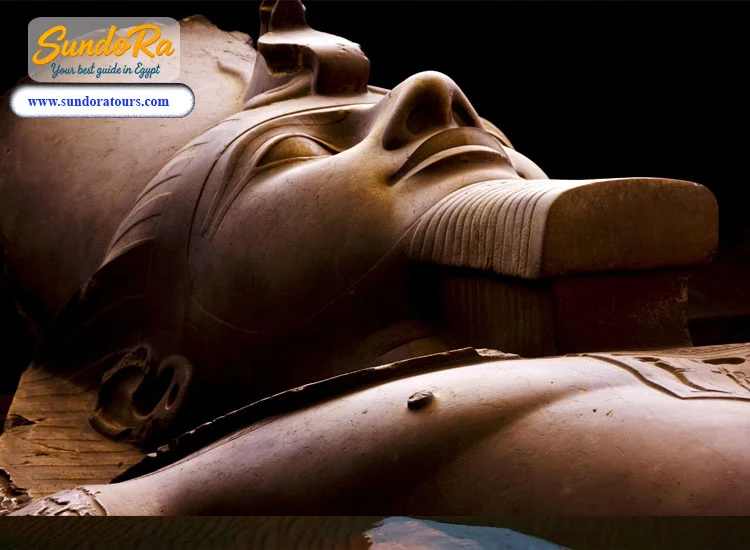
The open air Museum of Memphis
A Brief History
Memphis is recognized as the earliest capital of ancient Egypt, established soon after the unification of Upper and Lower Egypt. The city was founded during the First Dynasty, around 3100 BC, by King Narmer. Situated about 20 kilometers south of modern Cairo, Memphis served as the heart of Egypt’s political and cultural life throughout the Old Kingdom.
The city’s name, Memphis, originates from the ancient Egyptian term Men-Nefer, which later evolved through Greek influence. Today, the site corresponds to the modern village of Mit Rahina.
The chief deity of Memphis was the god Ptah, revered as the creator and patron of craftsmen. He was worshiped alongside his wife, the lioness goddess Sekhmet, and their son, the lotus god Nefertem.
Although little remains of the ancient city today, several remarkable relics survive from the New Kingdom and later periods. Visitors can explore the open-air museum that houses a colossal limestone statue of King Ramses II (circa 1305–1237 BC) and a massive alabaster sphinx weighing over 80 tons, once positioned outside Ptah’s grand temple. Other notable remains include granite statues of Ramses II, stone coffins, and inscribed stelae from subsequent eras.
See our Trip
Egyptian Museum
The open air Museum of Memphis
See more: dendera temple complex
Founding & Early History
- According to ancient tradition and later historians, Memphis was founded around 3100 BC (or somewhat later, around 2900 BC) by the pharaoh often called Menes (sometimes identified with Narmer) after the unification of Upper and Lower Egypt.
- Its location was strategic: near the entrance of the Nile Delta, on the west bank of the Nile, about 20-25 km south of modern Cairo.
- The original Egyptian name of the city was something like Men-nefer (“enduring and beautiful”) and another name was Hut-ka-Ptah (“Mansion of the Ka of Ptah”). The Greek name “Memphis” derives from Men-nefer.
Political & Religious Importance
- Memphis became the capital of Egypt during the Early Dynastic Period and the Old Kingdom (roughly from ~3100 to ~2181 BC).
- The city’s religious significance was immense: it was the seat of the worship of Ptah, the creator-god and patron of craftsmen. The great temple of Ptah in Memphis was one of the most important in ancient Egypt.
- It also held ceremonial functions: coronation rites and the Heb-Sed festival (a jubilee celebrated by the king) were associated with Memphis.
Later Periods & Decline
- Under the Middle Kingdom (c. 2080-c. 1760 BC), Memphis remained influential in the administration and arts, even if other cities rose in importance.
- In the New Kingdom (c. 1539-c. 1077 BC), Memphis continued as a major centre; while the capital may have shifted to places like Thebes, Memphis retained its religious, administrative and economic roles
- Over subsequent centuries, Memphis was besieged and ruled by foreign powers (e.g., the Assyrians, Persians). Its importance gradually diminished, especially under Christian and Islamic rule.
- Eventually, after the Muslim conquest (around 640 CE), the site was largely abandoned, and many of its stones were reused in later buildings.
Archaeology & What Remains
- The site of ancient Memphis is near the modern village of Mit Rahina (or Mīt Ruhayna).
- Because much of the ancient city was built from perishable materials (mud-brick) and reused later, only a few major monuments remain, but they are impressive.
- Notable surviving treasures include:
- A colossal limestone statue of Ramesses II (New Kingdom, 19th Dynasty) which once stood in front of the Temple of Ptah.
- The “Alabaster Sphinx” of Memphis: carved from a single block of alabaster (or calcite/linestone equivalent) weighing approx. 80 tons. Its exact pharaoh attribution is uncertain.
- The larger necropolis area of Memphis includes the pyramid fields from Giza, Saqqara, Dahshur, etc. These cemeteries and tombs reflect the city’s historic importance.
- The site (Memphis and its Necropolis) was designated a UNESCO World Heritage site in 1979
Why Memphis Mattered — Summary
- Strategic location: at the mouth of the Nile Delta, a natural gateway between Upper Egypt and the Delta.
- Political primacy: Long served as the capital and administrative heart of ancient Egypt.
- Religious significance: The cult of Ptah (creation, craftsmanship) was centered here, giving Memphis spiritual weight.
- Cultural continuity: Over several millennia Memphis remained relevant in various roles (religious, administrative, economic).
- Archaeological treasure: The surviving monuments provide insight into Egypt’s evolution over dynasties.