The Hanging Church
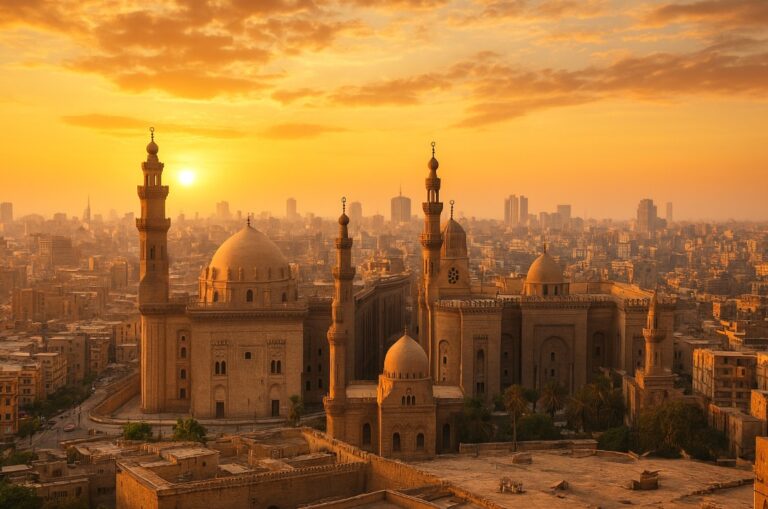
The Hanging Church, also known as Al-Muallaqa, is one of the oldest and most significant Coptic churches in Al-Fustat (Old Cairo). Its name comes from its unique architectural position: the church was built over the remains of two ancient towers belonging to the Roman Fortress of Babylon, giving the impression that it is “hanging” above the ground. The church is dedicated to the Virgin Mary and St. Dimiana, and it remains one of the most visited religious sites in Egypt.
Origins and Early Development
The construction of the Hanging Church dates back to the late 3rd century and early 4th century A.D., though historical evidence suggests that an even earlier structure may have existed on the same site. Some historians believe it might have originally been a Roman temple, later converted into a Roman church before eventually becoming a Coptic church. This theory gained strong support in 1984, when restorers discovered hidden wall scenes on the western side of the right aisle depicting pagan Roman gods—covered for centuries beneath layers of plaster.
The Church as a Patriarchal Seat
The Hanging Church played a central role in the development of the Coptic Orthodox Church. When the Patriarchate was relocated from Alexandria to Fustat, the church became the official residence of the popes for centuries.
The first patriarch to perform the Holy Liturgy here was Pope Christodolos, the 66th Patriarch (1039–1079 A.D.). The church continued to serve as the spiritual seat of the Coptic Pope until the 14th century, when the center moved to the Church of Abu Sefein.
Coptic Icons and Artistic Heritage
Inside the Hanging Church, visitors will find 110 religious icons, representing centuries of Coptic art.
- The oldest icon dates back to the 8th century.
- Many others belong to the 18th century, including several gifted in 1898 by Nakhla Al-Baraty Bey, who oversaw the church at the time.
In 1671, the French monk Vansleb, sent by King Louis XIV to study Egypt’s churches, recorded that he had seen inscriptions attributed to Amr Ibn al-As, the Muslim commander who conquered Egypt. According to Vansleb, Amr wrote instructions urging Muslims to treat this sacred church with respect—a testament to Egypt’s long tradition of coexistence.
Architectural Plan of the Hanging Church
The Hanging Church features a classic basilica layout, with a wooden roof ingeniously shaped like Noah’s Ark. While the church was historically much larger, numerous renovations, most notably by Obeid Bin Khozam in 1755 A.D., reduced it to its current layout:
- Length: 23.5 meters
- Width: 18.5 meters
- Height: 9.5 meters
The church comprises:
- The narthex (entrance hall)
- The nave with two side aisles
- Three eastern sanctuaries, the central one dedicated to the Virgin Mary
A series of steps leads up to the main entrance. On each side of the entrance are doors leading to the upper floors, historically used as the priests’ residence. Just before entering, visitors pass through a vestibule once used as a waiting and resting area for guests.
Interior Design and Notable Features
Aisles and Columns
Inside the church, the southern aisle is separated from the nave by eight marble columns, all linked by a wooden architrave resting on arches. The northern aisle has the same number of marble columns but lacks the architrave.
Small Church and Baptistery
In the southern aisle, a door leads to a small attached church that contains an ancient baptistery. This deep basin, carved from reddish granite, is believed to date back to the 5th century and features hieroglyphic symbols representing water.
Main Sanctuary
The central sanctuary—dedicated to the Virgin Mary—is the most important. It contains:
- A marble altar
- A decorated wooden dome, resting on four marble columns
- Religious scenes showing Jesus enthroned, surrounded by the Four Evangelists, apostles, and angels
The Pulpit
In front of the altar stands a remarkable pulpit supported by 15 columns. These columns symbolically represent:
- Jesus Christ
- The Twelve Apostles
- John the Baptist
- The Virgin Mary
The Seven Altars
The Hanging Church contains seven altars in total:
- Three in the main sanctuary
- Three in the right sanctuary (including the altar of St. Tekla Haimanot, the Ethiopian saint)
- One recently discovered on the northern side